/* Use this with templates/template-twocol.html */ The Path to Wealth: Credit
Showing posts with label Credit. Show all posts

Monday, December 8, 2008

Any Negative Item Will Be Deleted After Seven Years, Right?

Wrong. While it is true that negative items should be deleted after seven years--ten years for bankruptcy--they very rarely are. Of all the complaints I get about credit errors, the most common is that the items in question are more than seven years old. In all honesty, the credit bureaus are not in the business of ensuring accuracy or making sure your items are deleted on time. It's been my experience that these items stay on there until you do something about them.

So, you either need to dispute them yourself or hire someone to do it for you. You can do it yourself. If you don't want to hassle with it, I recommend Lexington Law Firm


Don't think that these items will take care of themselves. You must take the necessary steps to protect your credit, and don't think that nothing can be done. 78% of Americans have errors on their credit reports, and thousands of errors are deleted everyday. Good Luck

Will My Collection Account be Deleted When I Pay It?

Many people think that to repair their credit, they just need to pay off whatever derogatory item is affecting their score. This is false. Your collection, charge-off, or late payment will not be deleted when paid or settled. Once the item is paid, it will stay as a collection, charge off, etc.; the credit bureaus will simply add a line that says it has been settled or paid. Your score will remain negatively affected, and now you will have to wait 7 years from your latest payment.

That being said, is it not wise to pay on a derogatory account? I always recommend that people pay their obligations. Once an item has been paid, it is much easier to remove. The reason for this is that the collection agency or creditor is no longer interested in verifying the information to the credit bureaus when disputed.

Sunday, November 16, 2008

Three Ways to Add Good Credit

Piggyback

The best possible way to add good credit or establish credit if you have none is to piggyback on someone else’s credit. If you have a friend or relative whom you trust immensely to pay all their bills on time, you can ask them to request a credit card for you as a secondary card holder. By doing this, their credit card company will regularly report to the credit bureaus in your name. This gives the effect of you having been approved for a credit card, though you really didn’t have to do anything.

The one pitfall here is that if you’re friend does not pay their obligation on time, then their negative information will be reported in your name. The best way to avoid any complications is to be made a secondary holder on a credit card that is never used. On the flip side, don’t even allow your friend to give you the card. They can just cut it up or keep it. Either way, it will still be an effective method to build credit for you. Remember, you don’t have to use credit cards to build credit; you just have to have them.

Get a Secured Credit Card

The great thing about a secured credit card is that you don’t have to have credit to get it. You just need to be able to give the $200-$300 up front or whatever you want your spending limit to be. I recommend that you just take the minimum limit and do not use the card. Even though the company is not technically granting you credit—you are securing the spending limit with a savings account—they still report to the credit bureau the exact same way as any other credit card company, providing you with a great opportunity to build credit.

Seek Easy Credit

When it comes to obtaining a credit line, there are definitely some lines that are more easily obtained than others. If you don’t have excellent credit, don’t try to apply for an American Express card. What you can do is go to one of the following merchants:

· Jewelry Stores

· Furniture Stores

· Appliance Stores

· Credit Unions

· Clothing Stores

All of these institutions typically require a lower credit score to be approved. These are places that approve people easily but still report to the credit bureaus which makes them invaluable when it comes to establishing credit.

Things that Will Not Help You

I get so many people that tell me they should have good credit because they have paid their utility bill on time or their cell phone bill on time. Remember, utility companies, landlords, cell phone companies do not ever report positive information. They will only report to the credit bureaus if you fail to pay your obligations. In a word, the can only hurt, not help.


If you like our articles, subscribe for free to The Path to Wealth

Thursday, October 16, 2008

What's in Your Credit Score?

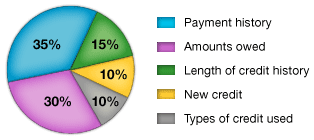
Credit scores are compiled form five different categories. The five categories are as follows and weigh in by the following percentages into your credit score:


Payment History


In the payment history category, they are looking for how many accounts you have that are considered “paid as agreed.” Also, the types of accounts will be treated differently. Whether or not you have any late payments and to what degree they are late is looked at. How much is past due will factor into your score.

Amounts Owed

In the amounts owed category, how much that is owing will factor into the score. The number of accounts with balances will factor into your score, so if you have a balance on all your accounts you will get a large point deduction. Conversely, if you have no balance on all of your accounts, you will get points added to your score. One other factor that is seriously considered is the proportion of credit lines used. Anytime your credit line exceeds 30% of the balance, your score will suffer, and more points will be deducted proportionate to the percentage of total credit line that you owe.

Length of Credit History


In this category, the credit calculators will look at how long your accounts have been open. Typically, this is looked at in terms of average length per account. The longer your average length per account, the better your score will be.

New Credit

In the new credit category, your score will be affected by the number of recently opened accounts that you have, the number of recent credit inquiries, and time since last credit inquiry. If you run out and apply for many accounts at once, your score will suffer as this would suggest that you are desperate for credit.

Types of Credit

This portion of your score is based on the number of or prevalence of any one type of account whether it be mortgage, installment loans, credit cards, retail accounts, etc.

If you want a cheap way to monitor your credit score, I recommend MyFico. They will monitor your score and send you both an email and text message whenever your score changes. They also have great tools for disputing credit mistakes and so on. You can click on the link below to go to their credit monitoring info page.

Monitor Your FICO® Score & Equifax Credit Report

What to Do If you Have Bad Credit

Unless you have no connection to the outside world, then I’m sure you are fully aware of the credit crisis we are experiencing in this country. This credit crisis essentially has happened because loans were granted to people that could not afford them. That being said, does that mean that if you have bad credit there is no way to get a loan or credit card? NO. You can still get loans. There are a lot of people that have bad credit that really can afford the loans for which they are applying, but they are paying for mistakes of their past or they recently went through a divorce, medical emergency, or some other life-altering condition that caused the bad credit. If you are one of these people, you need to get started repairing your credit. If you have the time to do it yourself, that’s great. If you don’t, then you may want to consider paying for credit repair service. I recommend Lexington Law; you can find a link on our site to them. I personally have used them, and I think they offer a very fair-priced and effective service.

Make Sure You Qualify


Now, as far as getting a loan with bad credit, there are two things that you need to do. First, you need to specifically ask companies whether or not they do loans for people with bad credit. Don’t waste your time and hurt your credit score more by getting rejected by multiple banks. Just ask them whether or not they do loans for people with bad credit and ask them what the qualifications are. I don’t ever apply for anything that I don’t already know I will be accepted for. I bring in my credit reports and scores from all three bureaus (look up my post on credit monitoring). I show the loan officer what I have, and let him determine whether or not I would be accepted before I give them the ok to run my credit and so forth. I think this is essential. It is also essential to be very forward with people if you have bad credit.

Be Forward


If you have bad credit, let any bank or mortgage broker know that up front. Tell them you have bad credit and ask them if they can deal with you. If they say yes, then you need to find out how they qualify applicants. For many people, they just go strictly off of your F.I.C.O. score and income. You want to talk to someone that will manually underwrite your loan. This means that they will be willing to hear your explanation of the bad credit and judge personally whether or not you can make the payments instead of just categorize you based on numbers.

Bad Credit and Credit Cards

The same rules apply concerning credit cards. Make sure that the card company has programs for people with bad credit, and decide whether or not you’ll be accepted for such a program before you apply. Remember, every time you allow your credit to be run, it will hurt your score. It may not decrease it much, but it will decrease it some; and the more inquiries you have, the more than tend to negatively impact your score. If you absolutely cannot get a card, then apply for a secured credit card. You will have to deposit money to secure your account, but the card will report to the bureaus the same way any other card company would do, allowing you to improve your credit and add a positive account history to your report.

Bad Credit and Your Terms


Remember, just because you can get a credit card or a loan with bad credit, don’t become complacent about improving or correcting your credit score. Do everything you can to have a solid score (680+), because your options and terms for credit will improve greatly if you have a good score. Don’t be a victim to lenders that prey on people with bad credit. I do real estate investing as a hobby, and I recently bailed out a homeowner that was paying 18% interest on his second mortgage. He couldn’t do it any longer, and he was going to lose the house because of it. Just because you might get accepted, this doesn’t mean you should go forward with it. Review the terms and be wise about what credit obligations you take on.

And Finally, you can always fix bad credit. Look at this post for information about disputing your bad credit history. If you don't have the time hire Lexington Law Firm

Friday, October 10, 2008

Tired of Credit Offers? Opt Out

If you are tired of getting credit card offers in the mail, there is an easy fix: opt out. You can go the opt out webpage. Here, you will be required to enter some information. Once you have finished the process, you have officially opted out of credit offers.

This right is afforded you by the FCRA (Fair Credit Reporting Act). The best part about opting out is that you should see your score increase. This is because you are no longer receiving soft hits on your credit score.

Monday, October 6, 2008

How to Build Business Credit

If you are at the point of wanting to build business credit, I’m going to assume that you have already set up your business and filed all the appropriate paperwork for licensing and so forth. Having that out of the way, you are now ready to start building credit for your business. Here are the steps

Open a Business Checking Account

This is important in showing that your business is established. It will all be monitored by Dun & Bradstreet. Soon enough, you will be rated based on the amount of money you hold in your account at all times. For now, just worry about getting it set up.

List Your Business

You should take the time to have your business listed on 411 search, yellow pages, and google business. Also, if you have a website, make sure it is listed with all the major search engines. It is recommended that you have your phone and a fax numbered registered in your business name.

Dun & Bradstreet

DNB is the largest tracker of business credit. They keep track of business credit; and for a fee, they sell different business profile options and business credit reports. You will need to get on their website and apply for a DUNS number. This number acts as an identification number for your business. It typically takes 30 days for them to set this number up, and you don’t need to pay for it. They will make the file and add to it as soon as you start applying for credit under your business name.

Start Applying

At this point you can start applying for credit. The easiest place to set up credit is with vendors with whom you already have a relationship. Also, you can try office supplies stores such as staples, Kinkos, etc. These office supply/print stores typically grant credit easily to businesses. Some business credit cards are given very easily; others require a longer history. You can always work your way up. Try to get at least 5 vendors or creditors that will report your credit.

Pay Early

You will be given a Paydex rating for your business. Besides the amount of money in your account, they will also look at how long it takes you to pay your “net 30” bills. I recommend that you pay them as soon as possible, because each day counts in the world of business credit. Paying them in fifteen days is better than paying them in 20. You want the best Paydex score you can get. The better your score is, the better your opportunities for loans.


If you like our articles, subscribe for free to The Path to Wealth.

Friday, October 3, 2008

How to Dispute an Error on Your Credit Report

One of the many problems with our credit system is that it allows for so many errors to show up on our credit reports. With identity theft increasing at an alarming rate, you need to monitor your credit report and remove the errors fraudulent activity. There are two general ways to remove a discrepancy from your report and rebuild your credit. I will show you how.

The Company

I have found the best way to remove any error or problem is through the company that issued it, if I am still a customer. For instance, assume you just had a late fee show up from American Express, and you are a customer of American Express. The most effective way to remove it is to write American Express a letter. If you tell them that you are loyal customer who loves American Express, and you need their help in removing the error. They will cordially oblige, because they want to keep you as a customer—a happy one incidentally.

Most people overlook this and go straight to the bureaus. The problem with this is that the bureaus are designed to be mechanical. They don’t care about your situation. They will process the information they are given. If you send them a letter, they will contact American Express. American Express will respond that it is valid. Now, if American Express does notice their error (not very likely), they will respond that it is erroneous and the bureau will delete it. However, if American Express just responds that it’s valid, you get a letter back saying it has been verified.

For this reason, I want to contact the company first. They have an interest in me as a customer; they want to keep me satisfied. I can add a personal touch with them which will make them want to help me. Here’s the real bonus though. Most of the time, they will delete a late payment for you, even if it’s not an error. Why? Because they are making money off every purchase you make. Why would they want to estrange and upset you? If they don't want to help you, then maybe you ought to look for a new card. Talk to the business first.

Through the Bureaus

If you do need to contact the three monsters: Transunion, Equifax, Experian, you will have to write three letters because they do not corroborate or work together. You will have three battles that are not easily won. The good news is that you have a couple advantages. The bad news is that there are some pitfalls to watch out for.

What’s on Your Side


Time is your first ally. Everyone knows that the FCRA (Fair Credit Reporting Act) requires the bureaus to respond to your letter in 30 days. If they do not, they technically have to delete it. This sounds great; but I will be honest, this does not happen very often.

Hassle

The other thing that you have going for you is that it is a hassle for the bureaus and the companies with whom they are investigating to verify this information. If the company has lost the information or simply ignores the request for validation long enough, the bureau will delete it because it cannot be verified or it took too long to verify it.

What’s Against You

Be prepared. The credit bureaus have some tricks up their sleeves. Anything they can do to deter you from pursuing your investigation they will try to do. They don’t want to have to spend the man hours investigating your errors. They want you to give up, accept it, and forget about it.

The Blanket Refusal

Invariably, if you send a dispute letter, you will get a blanket refusal to investigate based on several frivolous reasons. Depending on the bureau, they will say that the letter seemed to be a form letter, and they need to verify it was actually you who sent it. They will tell you that you have to prove your identity and place of residence first. The list goes on. These are meant to deter you.

What you can do


The best thing that you can do is put your social security number in your letter and attach a copy of your driver’s license and a proof of residence. This way, they cannot say they did not know it was you disputing it, and they cannot return your letter and say verify your identity.
Here are the addresses to the bureaus:

Experian
P. O. Box 9595, Allen, TX 75013-9595 Tel: 888-397-3742

Equifax
P. O. Box 740241, Atlanta, GA 30374-0241 Tel: 800-685-1111

Trans Union
P. O. Box 1000, Chester, PA 19022 Tel: 800-888-4213


Remember, the best way is to start with the company. If that does not work, move on to the bureaus. Success with the bureaus depends upon persistence. Good Luck.

P.S. If you decide that it's too much trouble to do it on your own, I recommend Lexington Law Firm


If you like our articles, subscribe for free to The Path to Wealth.

Four Myths about Credit Debunked

For most people, credit scores are something of an enigma. We all understand the basic underlying principle—if I pay my bills, I’ll have good credit—but few of us actually know the details involved in calculating a credit score. Worse yet, many of us hurt our scores because of our lack of understanding. Here are four commonly-held myths about credit that are holding you back.

Myth #1: Too many credit cards will hurt my credit score.

This commonly-believed myth about credit hurts people in a couple ways. First, I’ve interviewed many people who have cancelled all but two of their credit cards because they believed that these cards were hurting them. The truth is that the moment they cancelled their cards, their scores dropped by as much as 150 points. Yes, it is true. By cancelling your cards, you reduce the number of healthy accounts you have, which lowers both the amount of credit you have been granted and, in most cases, the average length of credit history for each account, reducing your score drastically.

Secondly, too many people refuse credit applications because they fear they will have too many accounts. Fair Isaac Corporation, the company that designed the formula for credit scoring, says that the average consumer has 13 credit obligations. However, adding more accounts does not hurt.

On the other hand, it is true that too many credit inquiries will hurt your score. In other words, if you are out applying for a new card or loan every week, your score will be lowered. This is also another reason why you need to get the credit accounts you desire and keep them. Do not whimsically apply for and cancel credit accounts.

Myth #2: I have to use my credit cards to build credit.

This is the classic myth; it’s everywhere. How many people have you heard say “I use my card once a month so it shows activity on my account?” I used to believe this one myself, but here is the truth: you don’t have to use your card at all. In fact, it’s better if you don’t. Fair Isaac Corporation says that the average consumer carries a balance of 30% of their credit line. If you go over this, your score will be lowered. If you stay under this, your score will be raised. If you have a zero balance, you will get the most points possible. They only report balance and payments; whether or not it’s been used is superfluous.

Myth #3: I should have good credit; I pay my utilities and cell phone bill on time every month.

This is one of the sad facts about credit. It may be used to determine your ability to pay for everything you do, but not everything you do will reflect on your ability to pay. In other words, your cable company, phone company, gas company, etc., are all going to check your credit (they probably won’t tell you either). However, because these institutions are not granting you credit, they will only report to the credit bureaus if you fail to pay. In other words, when it comes to phones, utilities, and cable, you can only hurt your credit, not build it.

Myth #4: There is nothing I can do once I have a late payment.

This one has got to go. It’s actually extremely easy to remove a late payment, and the sooner you do it the better. Removing a late payment from years ago can be a little more difficult, though definitely doable, than removing a late payment from last month. If you show a late payment on your transaction history, call your credit card company and you’ll be amazed how easily they will remove it. Call the company and get a customer service representative on the line. I simply say “I have a favor to ask of you. I have a late payment showing here on my account record. Is there any way you can remove that for me? I’d really appreciate it.” I’ve actually never had a credit card company refuse my request. Why? Because they want me to keep using their card, that’s why. Now, that’s not to say you can be late all you want. If you are late each month, then you probably aren’t going to get much help. If you were late one time in a year, I’m sure you’ll be helped. I can also tell you that a penitent tone will get you further than yelling. In the past, I’ve simply told them that I spaced the payment, and they have been accommodating for me.

You may not like the credit game, but we all have to play it. So, you might as well know the rules. With these four myths debunked, you are that much closer to having excellent credit and better borrowing capabilities.

If you like our articles, subscribe for free to The Path to Wealth.